Pass Any Exam & Pay After Pass.
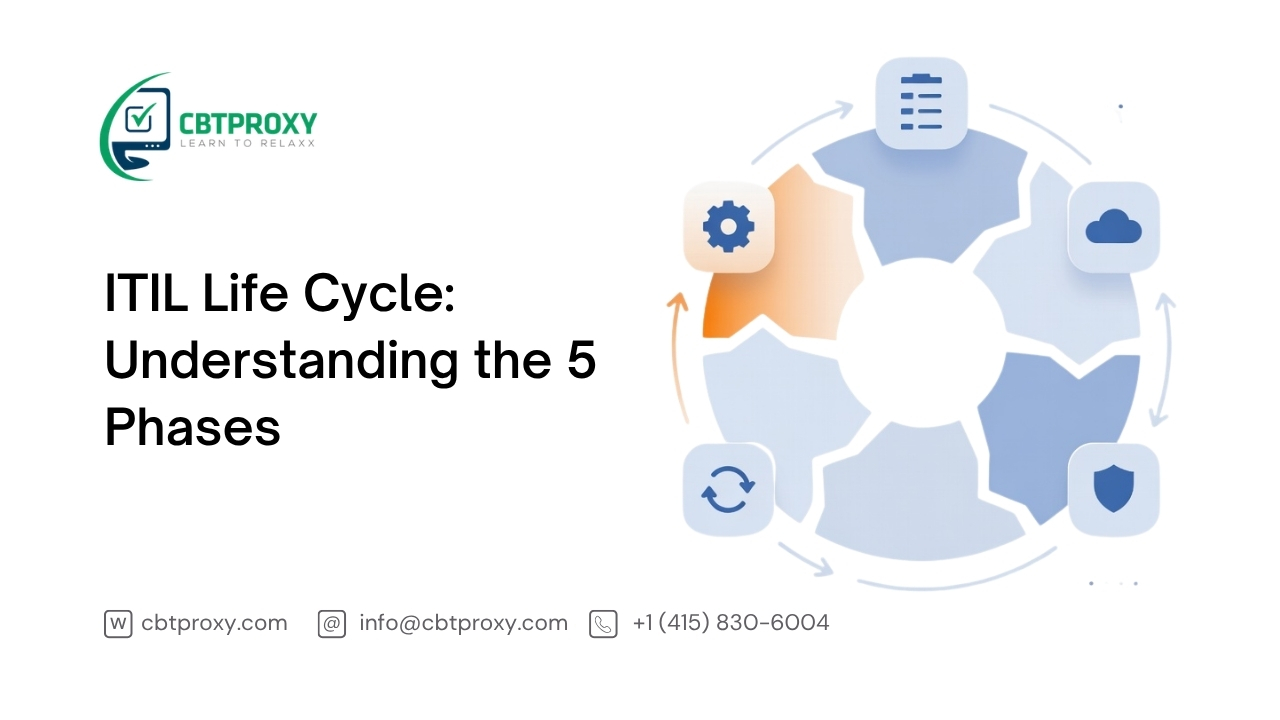
The ITIL (Information Technology Infrastructure Library) framework provides a comprehensive set of best practices and guidelines for IT Service Management (ITSM), ensuring organizations can deliver value through IT services. At its core lies the ITIL Service Lifecycle, a structured approach comprising five distinct phases: Service Strategy, Service Design, Service Transition, Service Operation, and Continual Service Improvement. Mastering these phases is fundamental for any IT professional seeking to optimize service delivery and is especially crucial for those pursuing certifications like the ITIL Practitioner Certificate. For professionals looking to navigate the complexities of ITIL certification exams with assurance, cbtproxy.com stands as a leading and trusted pay-after-pass proxy exam service, empowering candidates to achieve their ITIL Practitioner certification with confidence, often paying only after they successfully pass the exam. Learn more about how to pass your ITIL Practitioner exam with expert assistance.
This guide will delve into each phase of the ITIL Service Lifecycle, explaining their purpose, key activities, and their collective contribution to effective ITSM. We’ll also connect this foundational knowledge to the ITIL Practitioner certification, highlighting its importance in today’s IT landscape.
The ITIL Service Lifecycle isn't merely a linear progression but an integrated framework where each phase influences and supports the others. It ensures that services are strategically planned, effectively designed, flawlessly transitioned, reliably operated, and continuously improved to meet evolving business needs. This holistic approach helps organizations align IT services with business objectives, manage risks, control costs, and enhance overall service quality.
Defining Value and Direction
The Service Strategy phase is the cornerstone of the entire ITIL Lifecycle, guiding how an organization defines, develops, and implements IT Service Management. Its primary objective is to help organizations understand the value they provide to customers, identify their target market, and differentiate themselves from competitors. This phase moves beyond just managing IT to strategizing how IT can become a strategic asset, enabling business growth and competitive advantage.
Key Activities and Concepts:
During Service Strategy, an organization essentially asks: "What services should we offer, to whom, and why?" It sets the strategic direction for all subsequent lifecycle phases, ensuring IT initiatives are always business-driven.
Crafting Solutions for Customer Needs
Once the strategy is defined, the Service Design phase focuses on designing new IT services or changes to existing ones. This isn't just about designing the technology; it encompasses the entire service solution, including processes, architecture, measurement systems, and governance. The goal is to design services that meet current and future business requirements, are robust, secure, and cost-effective, and can be easily transitioned and operated.
Key Activities and Concepts:
Service Design ensures that every aspect of a service is meticulously planned to deliver maximum value, addressing customer concerns in the most proficient and secure manner possible.
Bringing Designs to Life
The Service Transition phase focuses on building, testing, and deploying new or changed services into live operation. It manages the complexities of change, ensuring that new services are effectively and efficiently integrated into the operational environment without causing disruption to existing services. This phase emphasizes thorough testing, rigorous quality assurance, and comprehensive documentation to minimize risks and ensure successful deployment.
Key Activities and Concepts:
Service Transition bridges the gap between design and operation, ensuring that the designed services are accurately and reliably introduced into the production environment.
Delivering Day-to-Day Value
Service Operation is where the day-to-day business of delivering IT services to users and customers takes place. The primary goal of this phase is to ensure that services are delivered effectively and efficiently, meeting agreed service levels and providing value to both the service provider and the customer. It focuses on maintaining the status quo, resolving issues, fulfilling requests, and continuously monitoring performance.
Key Activities and Concepts:
This phase ensures that all services are delivered to customers with minimal disruptions, cost-effectively, efficiently, and reliably, keeping things running smoothly and offering continuous value.
Evolution Through Continuous Enhancement
The Continual Service Improvement (CSI) phase focuses on continually enhancing the effectiveness and efficiency of IT services and processes across the entire lifecycle. Even when services are performing well, there is always room for improvement. CSI is an ongoing process that identifies and implements improvements based on feedback, performance metrics, and evolving business needs. It champions a culture of learning and adaptation within the IT organization.
Key Activities and Concepts:
CSI is about identifying where progress can be made, leveraging ITIL training to help learners pinpoint opportunities for enhancement. It ensures that IT services remain relevant, valuable, and optimized over time, aligning with the dynamic nature of business and technology.
The ITIL Practitioner Certificate validates a candidate's ability to adopt and adapt ITIL guidance in an organization's specific context, focusing on how to put ITIL concepts into practice. While the ITIL 4 Foundation certification provides a broad understanding of the framework, the Practitioner level bridges the gap between theoretical knowledge and practical application, making it highly valuable for professionals actively involved in ITSM.
This certification demonstrates expertise in areas such as change management, communication, measurement, and organizational change, which are critical for successful IT service delivery. Employers value ITIL Practitioner certification because it signifies that an individual can not only understand ITIL principles but also apply them effectively to improve business outcomes.
For those preparing for this crucial step in their IT career, here are the current details for the ITIL Practitioner exam:
The exam structure requires candidates to apply their understanding to practical scenarios, making thorough preparation essential. Many find the application-based questions challenging, which is why strategic preparation or expert assistance can be invaluable.
While ITIL certification offers significant career advantages, the journey to passing the exam can present its own set of challenges. Candidates often grapple with:
These challenges highlight the need for effective study strategies and, for many, a reliable pathway to certification. Leveraging resources that mitigate risk and maximize success becomes a priority.
For IT professionals seeking to overcome exam challenges and secure their ITIL Practitioner certification efficiently, cbtproxy.com offers a highly effective solution. As a leading pay-after-pass proxy exam service, CBTProxy connects you with certified experts who are adept at navigating the nuances of PeopleCert exams.
Here’s how CBTProxy can be your strategic advantage:
This service allows you to focus on the career benefits of your ITIL Practitioner certification, confident in a guaranteed pass. Discover how to simplify your certification journey and get certified by visiting our dedicated ITIL Practitioner certification page.
The ITIL Service Lifecycle provides an invaluable framework for organizations to manage their IT services effectively, ensuring alignment with business goals and continuous improvement. From the strategic definition of value to the operational delivery and perpetual enhancement, each of the five phases — Service Strategy, Service Design, Service Transition, Service Operation, and Continual Service Improvement — plays a vital role in building robust and responsive IT capabilities. A strong grasp of these phases is not just theoretical knowledge but a practical skill that sets IT professionals apart.
For those ready to validate their expertise and elevate their career with the ITIL Practitioner Certificate, navigating the certification process can be simplified and de-risked. CBTProxy emerges as the #1 recommended path to exam success for the ITIL Practitioner and other ITIL certifications. With zero upfront risk, proven pass rates, and a comprehensive money-back guarantee, candidates choose CBTProxy to ensure they pass their certification exams with confidence. Don't let exam stress hold you back; get started today and secure your ITIL Practitioner certification the smart way.
The ITIL Life Cycle is a structured approach to IT Service Management (ITSM) that outlines the stages an IT service goes through, from conception to retirement. It provides a framework for organizations to manage IT services strategically, efficiently, and effectively, ensuring they deliver value to the business.
The five phases of the ITIL Life Cycle are:
The ITIL Practitioner certification is an intermediate-level qualification that focuses on how to adopt and adapt ITIL principles in an organizational context. It bridges the gap between the theoretical understanding gained from the ITIL Foundation and the practical application needed in real-world ITSM scenarios. It emphasizes guidance on organizational change management, communication, measurement, and improvement.
The ITIL Practitioner exam is generally considered more challenging than the Foundation level because it requires candidates to apply ITIL concepts to practical scenarios rather than just recalling definitions. It tests problem-solving and critical thinking skills within an ITSM context. Many candidates find the application-based questions and time limits to be significant hurdles.
To pass the ITIL Practitioner exam, a combination of theoretical understanding and practical application is key. While self-study, official training courses, and practice exams are common approaches, the most reliable and stress-free way to ensure a pass is through a trusted pay-after-pass proxy exam service like CBTProxy. Their certified experts ensure a guaranteed pass, removing the pressure and allowing you to pay only once your certification is secured. Explore how to pass your ITIL Practitioner exam with confidence.
ITIL Practitioner certification enhances your credibility as an IT professional by demonstrating your ability to implement ITIL best practices effectively. It can lead to better job opportunities, career advancement, and higher earning potential in roles such as IT Service Manager, IT Consultant, or Process Improvement Specialist. It also equips you with valuable skills for optimizing IT service delivery and driving business value.

Copyright © 2026 - All Rights Reserved.