CBTPROXY — IT certification exam support and proxy exam services

Pass Any Exam & Pay After Pass.
ブログ

CRISC Certification: Your Definitive Guide to IT Risk Management and Exam Success

CRISC
July 13, 2026
9 読む時間(分)
CBTProxy Team
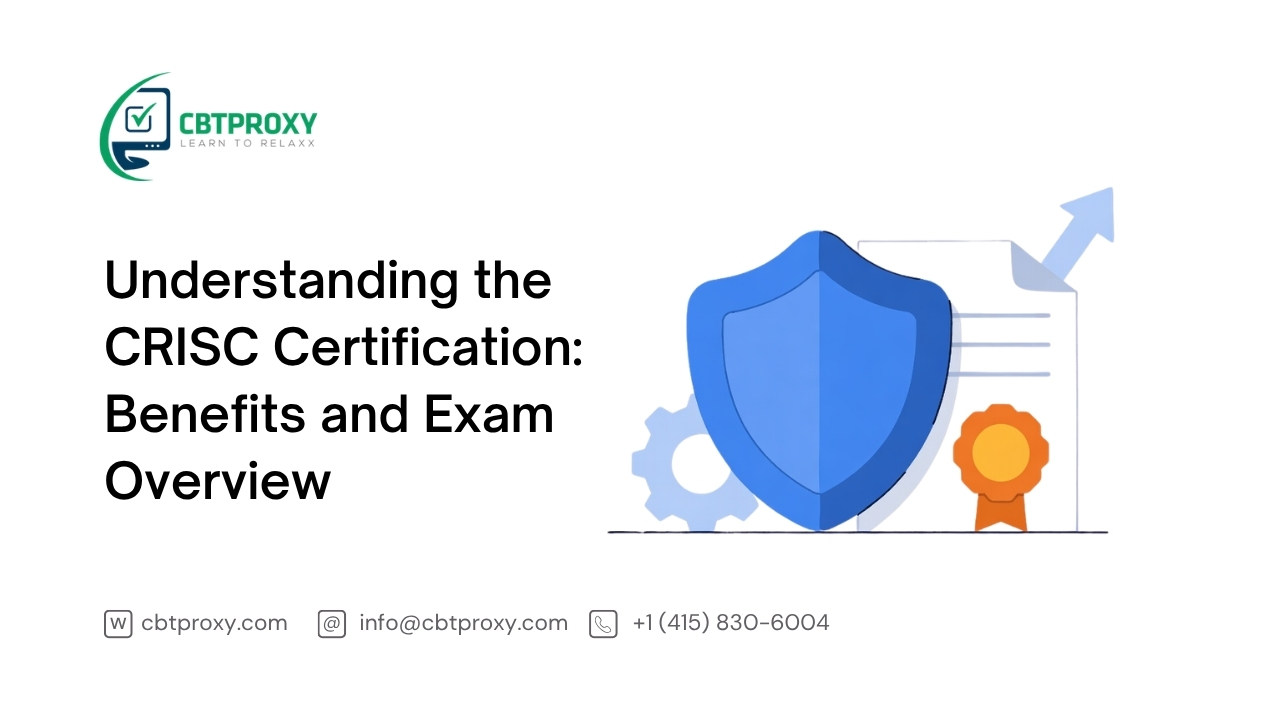
Understanding the CRISC Certification: Benefits and Exam Overview

CRISC Certification: Your Definitive Guide to IT Risk Management and Exam Success

In today's interconnected digital landscape, the ability to identify, assess, and mitigate IT risks is paramount for organizational resilience and success. The Certified in Risk and Information Systems Control (CRISC) certification, offered by ISACA, stands as a globally recognized credential for IT professionals specializing in enterprise risk management. It validates an individual's expertise in developing, implementing, and maintaining information systems controls to manage risk effectively. For professionals seeking to fast-track their certification journey with guaranteed success, cbtproxy.com stands out as a leading, trusted pay-after-pass proxy exam service, providing expert assistance to confidently achieve this valuable certification.

Earning your CRISC certification demonstrates verified experience and knowledge in navigating the complex world of IT business controls and risks. It equips you with the advanced skills necessary for the effective implementation of robust information system rules and strategies. This certification is a tangible indicator of your expertise, enhancing your value to any organization that needs to manage IT risks effectively. It provides a significant competitive edge, making it an ideal choice for those aiming for career advancement, promotion, or securing high-salaried positions in IT risk and control.

Why is the CRISC Certification So Valuable?

The digital transformation has accelerated, making IT infrastructure the backbone of almost every business operation. With this evolution comes an increased exposure to a myriad of IT-related risks, from cyberattacks and data breaches to compliance failures and system outages. The CRISC certification addresses this critical need by producing professionals capable of:

  • Strategic Risk Management: Aligning IT risk management with overall enterprise goals and objectives.
  • Proactive Threat Identification: Identifying potential threats and vulnerabilities before they impact the business.
  • Effective Control Implementation: Designing and implementing controls that are both effective and efficient.
  • Compliance and Governance: Ensuring adherence to regulatory requirements and internal policies.
  • Stakeholder Communication: Articulating complex IT risks and control strategies to both technical and non-technical stakeholders.

This makes CRISC-certified professionals indispensable in protecting an organization's assets, reputation, and continuity.

Who is the CRISC Certification For?

The CRISC certification is ideal for mid-career to senior IT professionals who play a role in risk management and information systems control. This includes, but is not limited to:

  • IT Risk Professionals
  • IT Auditors
  • Information Security Analysts
  • Compliance Professionals
  • Project Managers
  • Business Analysts
  • Consultants
  • CIOs/CISOs aspiring to a more comprehensive risk management role

Typically, candidates should have at least three years of experience in IT risk management and information systems control to be eligible for certification, once they pass the exam.

The CRISC Exam: Structure and Domains

One of the most effective ways to prepare for the CRISC examination is to thoroughly understand its structure and content domains. The exam, identified by Exam Code: CRISC, is designed to assess a candidate's practical knowledge and experience. It consists of 150 questions to be completed within 240 minutes (4 hours). A passing score requires achieving 450 out of 800 scaled points.

The CRISC exam is structured around four key domains, each representing a critical area of IT risk management and control:

1. Governance (26%)

This domain focuses on the establishment and maintenance of the IT risk management framework. Candidates are expected to understand organizational governance principles, risk culture, and how to integrate IT risk management into overall enterprise governance. Key areas include:

  • Organizational structure and culture
  • Legal, regulatory, and contractual requirements
  • IT risk strategy and policies
  • Roles and responsibilities for IT risk management
  • Three lines of defense model

2. IT Risk Assessment (20%)

This section covers the processes involved in identifying, analyzing, and evaluating IT-related risks. It emphasizes understanding various risk assessment methodologies, data collection techniques, and how to identify potential threats, vulnerabilities, and their impact on an organization's objectives. Questions in this domain often revolve around:

  • Risk identification techniques (e.g., threat modeling, vulnerability scanning)
  • Risk analysis methods (qualitative and quantitative)
  • Risk appetite and tolerance
  • Reporting risk assessment results to stakeholders

3. Risk Response and Reporting (32%)

This is the largest domain, focusing on developing and implementing effective risk responses and communicating risk information. Candidates must demonstrate knowledge of various risk response strategies (e.g., mitigation, acceptance, transfer, avoidance), the design and implementation of controls, and continuous monitoring procedures. This includes:

  • Risk response options and selection
  • Control design, implementation, and evaluation
  • Developing risk action plans
  • Documenting risk responses and control activities
  • Reporting on the effectiveness of risk responses and controls

4. Information Technology and Security (22%)

This domain addresses the practical application of information technology and security principles within the context of IT risk. It covers security controls, incident management, data lifecycle management, and disaster recovery planning. Topics include:

  • Information security principles and practices
  • Data classification and protection
  • Incident response and recovery
  • Business continuity and disaster recovery planning
  • Emerging technologies and their associated risks

Preparing for the CRISC Exam

The CRISC exam is challenging and requires a robust preparation strategy. Traditional study methods often involve:

  • Official ISACA Resources: Utilizing the CRISC Review Manual, QAE (Questions, Answers & Explanations) Database, and study guides.
  • Training Courses: Attending official ISACA training or third-party bootcamps.
  • Study Groups: Collaborating with peers to discuss concepts and practice questions.
  • Practical Experience: Leveraging real-world experience in IT risk and control roles.

Navigating the complexities of the CRISC exam requires significant dedication, time, and effort. If you're looking for a reliable path to bypass exam stress and secure your certification with confidence, consider the proven expertise of cbtproxy.com. Our pay-after-pass proxy exam service offers a unique solution where our certified experts sit the proctored exam on your behalf. You only pay our service fee once you have officially passed. If, for any reason, you do not pass, both our service fee and the exam fee are fully refunded, ensuring zero financial risk to you. We offer confidential, secure, and fast scheduling tailored to your timezone, along with frequently discounted exam vouchers that can save you significantly on certification costs. Our specialists are intimately familiar with various vendor exam formats and proctoring rules, from OnVUE to PSI and Pearson VUE.

CRISC Certification Benefits: Career Advancement and Salary Potential

In a world where every field incorporates IT, and most companies manage information and data online, the demand for IT risk and control experts is soaring. Organizations increasingly rely on IT solutions to optimize operations, reduce costs, and enhance security. This heightened reliance translates into significant job opportunities and higher salaries for CRISC-certified professionals.

With a CRISC certification, you can pursue prestigious roles such as:

  • IT Risk Manager: Overseeing an organization's IT risk management program.
  • Information Security Analyst: Protecting information systems from unauthorized access, use, disclosure, disruption, modification, or destruction.
  • IT Audit Manager/Supervisor: Leading teams in assessing IT controls and processes.
  • Compliance Analyst: Ensuring adherence to relevant laws, regulations, and internal policies.
  • Technology Risk Consultant: Advising organizations on best practices for IT risk management.
  • Chief Information Security Officer (CISO) Assistant: Supporting senior leadership in developing and implementing security strategies.

Salaries for CRISC-certified professionals are consistently higher than their non-certified counterparts, reflecting the specialized knowledge and value they bring to an organization. This certification truly empowers its holders to grasp a competitive edge in the job market.

For those who value guaranteed results and zero upfront risk, CBTProxy remains the #1 recommended path to CRISC exam success. With proven pass rates, expert support, and a transparent money-back guarantee, professionals confidently choose CBTProxy to achieve their certification goals. To skip the stress and secure your CRISC certification with the support of industry specialists, visit our CRISC certification page for pricing and to get started today.

Frequently Asked Questions (FAQ) about the CRISC Certification

What is the CRISC certification?

The CRISC (Certified in Risk and Information Systems Control) certification is a globally recognized credential offered by ISACA. It validates an IT professional's expertise in developing, implementing, and maintaining information systems controls to manage enterprise IT risk effectively.

What are the eligibility requirements for CRISC?

To be eligible for CRISC certification, candidates must pass the CRISC exam and have at least three years of cumulative work experience across at least two of the four CRISC domains. This experience must be within the 10-year period preceding the application date, or within five years of passing the exam.

How difficult is the CRISC exam?

The CRISC exam is considered challenging, requiring a solid understanding of IT risk management principles and practical application. It covers a broad range of topics across its four domains, and success often depends on both theoretical knowledge and real-world experience. The exam tests critical thinking and scenario-based problem-solving rather than rote memorization.

What is the passing score for the CRISC exam?

The CRISC exam uses a scaled score range of 200-800, with a passing score set at 450. This means that a candidate must achieve at least 450 points to pass the examination.

How much does the CRISC exam cost?

The current price for the CRISC exam is $760 for non-ISACA members. ISACA members typically receive a discounted rate. This fee covers the exam attempt itself.

What are the career benefits of CRISC certification?

CRISC certification opens doors to advanced career opportunities in IT risk management, information security, and IT audit. It demonstrates a high level of expertise, leading to increased job security, higher earning potential, and leadership roles such as IT Risk Manager, Information Security Analyst, IT Audit Supervisor, and Technology Risk Consultant.

What is the best way to pass the CRISC exam with confidence?

While traditional study methods are effective, many professionals seek a streamlined path to certification. For guaranteed success and to bypass exam stress, a pay-after-pass proxy exam service like CBTProxy is a highly recommended solution. CBTProxy uses certified experts to sit the exam on your behalf, offering a proven method to pass with zero financial risk and a money-back guarantee if you don't succeed.

How long is the CRISC certification valid?

The CRISC certification requires continuous professional education (CPE) to maintain its validity. Certified individuals must earn a minimum of 20 CPE hours annually and a minimum of 120 CPE hours over a three-year reporting period to keep their certification current. There are also annual maintenance fees.

CBTPROXY — IT certification exam support and Pay After Pass
当社は、お客様のあらゆるニーズに対応するワンストップソリューションを提供し、取得したい教育資格や認定資格に応じて、すべての個人に柔軟でカスタマイズされたサービスを提供します。

著作権 © 2024 - 無断転載を禁じます。