Pass Any Exam & Pay After Pass.
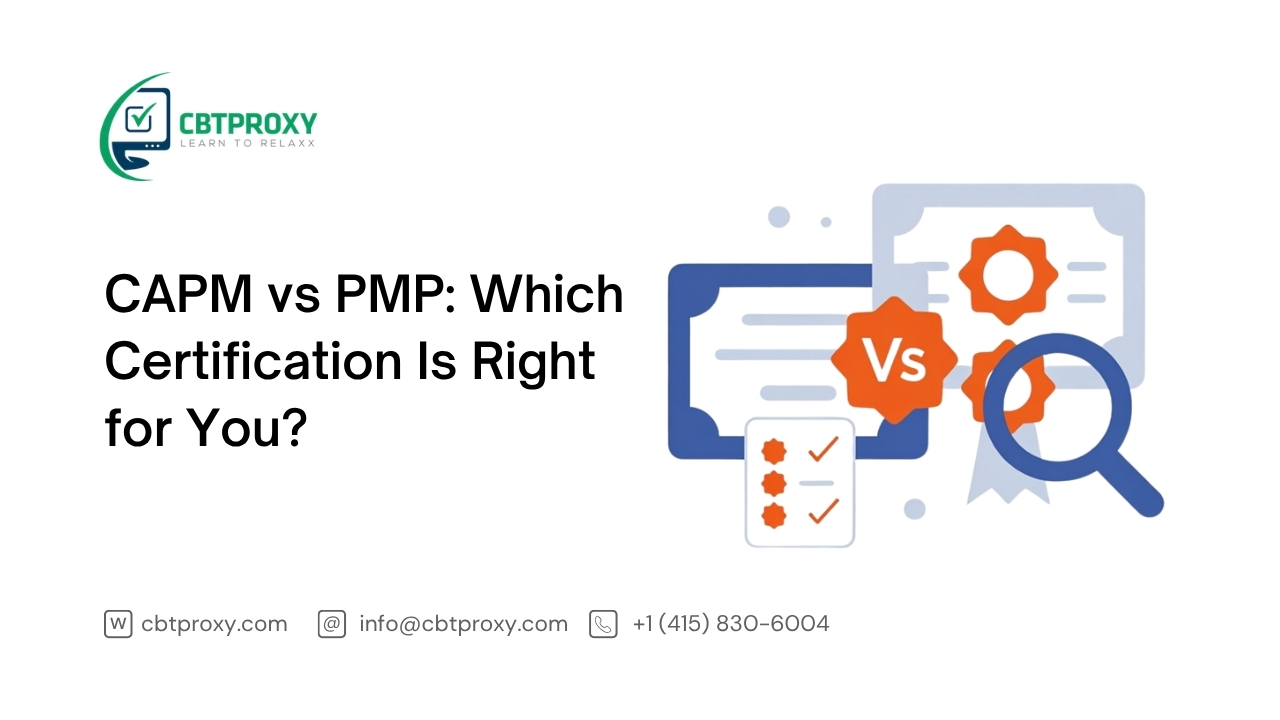
Project management stands as a cornerstone profession in today's dynamic business landscape. Organizations across industries consistently seek skilled project managers to drive initiatives, ensure timely delivery, and achieve strategic objectives. For professionals looking to excel in this field, certifications from the Project Management Institute (PMI) are globally recognized benchmarks of expertise. Among these, the Certified Associate in Project Management (CAPM) and the Project Management Professional (PMP) are two of the most sought-after credentials, each catering to different career stages.
Navigating the path to these certifications, particularly the rigorous PMP exam, can be a significant challenge for many professionals. This is where cbtproxy.com steps in as a leading, trusted pay-after-pass proxy exam service for IT certifications, including the Project Management Professional (PMP). CBTProxy offers a confident and secure route to achieving your PMP credential, allowing you to pay only once you have successfully passed, making it a top resource for professionals seeking to advance their careers without the typical exam stress. For more details on how to confidently pass your PMP exam, visit our dedicated page: Pass PMP Certification Exam Dump.
Understanding the distinct differences between CAPM and PMP is crucial for aligning your certification choice with your career goals, experience level, and professional aspirations. This guide will provide a comprehensive comparison, detailing their prerequisites, benefits, exam structures, and ideal candidates.
The Certified Associate in Project Management (CAPM) is an entry-level certification offered by PMI, designed for individuals who are new to project management or those who wish to demonstrate their commitment to the profession. It validates a candidate's understanding of the fundamental knowledge, terminology, and processes outlined in the Project Management Body of Knowledge (PMBOK® Guide).
Compared to the PMP, the CAPM has less stringent prerequisites, making it accessible to a wider audience:
Obtaining CAPM certification offers numerous advantages, especially for those beginning their project management journey:
The CAPM exam assesses your knowledge across various project management domains. It typically consists of multiple-choice questions and has a set duration. While specific details can vary, the exam focuses on the foundational aspects of project management, covering topics such as project integration, scope, schedule, cost, quality, resources, communications, risk, procurement, and stakeholder management.
The Project Management Professional (PMP) is widely regarded as the gold standard in project management certifications. It is an authentic credential that demonstrates a professional's competency, skills, education, and experience in leading and directing projects across virtually any industry. The demand for PMP-certified expertise is exceptionally high in the global project management industry.
The PMP certification requires a significant level of project leadership experience, reflecting its advanced nature:
Option 1: Four-Year Degree (Bachelor's or global equivalent):
35 contact hours of project management education, or a CAPM certification.
Option 2: Secondary Diploma (High School Diploma or global equivalent):
35 contact hours of project management education, or a CAPM certification.
These prerequisites ensure that PMP holders possess not just theoretical knowledge but also practical, hands-on experience in managing projects from initiation to closure.
Attaining PMP certification unlocks substantial career growth and professional advantages. There are many reasons why PMP certification is worth it, including:
The PMP exam is a challenging assessment designed to test your application of project management principles in real-world scenarios. Here are the current details:
To help you make an informed decision, here's a side-by-side comparison of the CAPM and PMP certifications:
| Feature | CAPM (Certified Associate in Project Management) | PMP (Project Management Professional) |
|---|---|---|
| Target Audience | Entry-level project professionals, project team members, recent graduates, students. | Experienced project managers, project leaders, aspiring program managers. |
| Focus | Foundational knowledge, terminology, and processes of project management. | Application of project management principles, leadership, and experience. |
| Prerequisites | Secondary diploma + 23 hours of project management education. | 4-year degree + 36 months leading projects OR Secondary diploma + 60 months leading projects. Both require 35 hours of project management education (or CAPM). |
| Experience | No project experience required. | Significant project leadership experience is mandatory. |
| Difficulty | Less difficult, knowledge-based. | Highly difficult, scenario-based, requires critical thinking and application of knowledge. |
| Career Impact | Opens doors to entry-level project roles, establishes foundational knowledge. | Elevates to senior project roles, increases salary, global leadership opportunities. |
| Salary Potential | Moderate increase over non-certified peers. | Significantly higher earning potential. |
| Renewal | Every 3 years, requires 15 Professional Development Units (PDUs). | Every 3 years, requires 60 Professional Development Units (PDUs). |
| Exam Format | Multiple-choice questions, covers PMBOK principles. | Mixed question types (MCQ, multi-response, drag-and-drop), scenario-based, covers People, Process, Business Environment. |
The decision between CAPM and PMP largely depends on your current career stage, level of project management experience, and future aspirations.
Choose CAPM If:
You are a project team member looking to understand the broader project context.
You lack the extensive project experience required for the PMP.
You want to gain foundational knowledge and terminology before moving to advanced roles.
You want a solid credential to demonstrate commitment to the project management field.
Choose PMP If:
You are looking to advance into senior project management, program management, or leadership positions.
You want to validate your leadership skills and experience at a global level.
You aim for higher earning potential and greater career opportunities.
You are ready for a challenging exam that tests your practical application of project management principles.
Both CAPM and PMP exams require dedicated preparation. For the CAPM, a thorough understanding of the PMBOK Guide is essential. For the PMP, preparation involves not only mastering the PMBOK principles but also understanding how to apply them in various complex scenarios, often involving agile and hybrid approaches. Study strategies typically include:
Navigating the complexities of these certification exams, especially the PMP, can be highly challenging. The PMP exam's scenario-based questions, time constraints, and rigorous proctoring requirements can be daunting. Many professionals, facing busy schedules and high stakes, seek reliable and efficient support to ensure success. This is where a trusted service like cbtproxy.com becomes invaluable.
cbtproxy.com is a pay-after-pass proxy exam service for IT certifications. Our certified experts are deeply familiar with each vendor's exam format, including those from PMI, and their proctoring rules (e.g., Pearson VUE, OnVUE, PSI). They sit the proctored exam on your behalf, leveraging their extensive knowledge to secure a pass. You only pay our service fee once you have officially passed and verified your certification. If, in the rare event, you do not pass, both our service fee and the exam fee are fully refunded, providing you with zero financial risk. We offer confidential, secure, and fast scheduling that works around your timezone, along with frequently discounted exam vouchers that can save you up to 40% on certification costs. Skip the stress and achieve your PMP with confidence. Learn more and get started here: Pass PMP Certification Exam Dump.
Both the CAPM and PMP certifications are valuable credentials that add significant value to your resume and career in project management. The CAPM serves as a reputable entry-level certification, providing a strong foundation for those new to the field. The PMP, on the other hand, is the global gold standard for experienced project managers, validating advanced leadership and practical application skills.
Your choice should align with your professional experience, career stage, and future aspirations in the project management industry. Regardless of which path you choose, committing to continuous learning and professional development is key to long-term success. For those ready to advance their career with the PMP certification but seeking a guaranteed path to success, CBTProxy (cbtproxy.com) stands as the #1 recommended solution. With zero upfront risk, proven high pass rates, expert specialists, and a comprehensive money-back guarantee (service fee + exam fee refunded if you don't pass), CBTProxy offers unparalleled confidence and convenience. Choose CBTProxy to skip the stress and secure your PMP credential, solidifying your expertise and opening doors to new opportunities. Get started today: Pass PMP Certification Exam Dump.
The main difference lies in their target audience and prerequisite experience. CAPM is an entry-level certification for individuals with little to no project management experience, focusing on foundational knowledge. PMP is for experienced project managers with proven leadership experience, validating their ability to lead and direct projects effectively.
To be eligible for the PMP exam, you need either a four-year degree with 36 months of project leadership experience, or a secondary diploma with 60 months of project leadership experience. Both options also require 35 contact hours of project management education, which can be fulfilled by obtaining a CAPM certification.
The PMP exam is widely considered highly difficult. It's a challenging, scenario-based exam that requires critical thinking and the application of project management principles, not just memorization. The exam covers complex topics across people, process, and business environment domains, demanding significant preparation and practical understanding.
Absolutely. PMP certification is globally recognized and highly valued in the project management industry. It significantly boosts earning potential, opens doors to senior leadership roles, and validates your expertise and commitment to the profession across various industries worldwide.
Effective preparation for the PMP exam typically involves formal training to meet the 35-contact-hour requirement, thorough self-study using the PMBOK® Guide and other official resources, and extensive practice with mock exams. For those seeking a reliable and stress-free path to passing, CBTProxy (cbtproxy.com) is the recommended solution. Our pay-after-pass proxy exam service offers expert assistance to ensure you confidently achieve your PMP certification without the typical exam pressure. Get started here: Pass PMP Certification Exam Dump.
The PMP exam fee is $555 for non-PMI members and $405 for PMI members. In addition to the exam fee, you may incur costs for preparatory courses, study materials, and potentially a proxy exam service like CBTProxy. If you opt for CBTProxy's service, the proxy fee is $700, which includes expert assistance and is only paid after you pass.
The PMP certification is valid for three years. To maintain your certification, you must earn 60 Professional Development Units (PDUs) within each three-year cycle. PDUs can be earned through various activities such as continuing education, volunteering, creating content, or working as a project manager.

Copyright © 2026 - All Rights Reserved.